


The sudden plunge into darkness is a universally unsettling experience. One moment, your home is a hub of activity—lights humming, appliances working, screens glowing—and the next, everything halts. While many power outages are the result of widespread grid failures, unpredictable weather, or utility company maintenance, a significant portion of electrical blackouts are isolated entirely to your property. When your home is the only one on the block sitting in the dark, the issue transforms from a community inconvenience into a localized crisis. The best guide to finding electrician Highlands Ranch CO.
Navigating a sudden blackout requires a calm mindset, a foundational understanding of your home’s electrical system, and knowing precisely when to call a professional electrician for power outage resolution. Whether you are dealing with a tripped main breaker, storm damage to your exterior equipment, or a localized short circuit, making the right decisions in the immediate aftermath can save you time, money, and potentially prevent dangerous electrical fires.
This comprehensive guide will walk you through everything you need to know about navigating home blackouts. We will explore how to safely assess the situation, determine whether the problem lies with your equipment or the utility grid, diagnose common internal failures, and ultimately, how to select the right expert to get your life back to normal.
Phase 1: Immediate Steps When the Lights Go Out
When the power fails, your immediate priority is safety. Before you reach for your phone to call for help or begin diagnosing the root cause, you need to secure your environment.
Prioritize Safety and Visibility
- Find a Safe Light Source: Keep high-quality, battery-operated LED flashlights in easily accessible locations. Avoid using candles, as open flames present a severe fire hazard, especially if the outage was caused by an internal electrical short or if there are unseen gas leaks.
- Unplug Sensitive Electronics: Surges are incredibly common when power is suddenly restored. Walk through your home and unplug computers, televisions, gaming consoles, and sensitive kitchen appliances. Leave one single light switched on so you will know immediately when the power returns.
- Keep Refrigerator Doors Closed: An unopened refrigerator can keep food safely cold for about four hours, while a full freezer will hold its temperature for up to 48 hours.
Assess the Scope of the Outage
Once you have secured your immediate surroundings, you need to determine the scope of the problem. Is this a neighborhood-wide blackout, a total loss of power to your specific house, or a partial outage?
Look out your windows. Are the streetlights on? Do your neighbors have lights visible in their windows? If the entire street is dark, you are experiencing a grid failure. In this scenario, your best course of action is to contact your utility provider to report the outage and monitor their updates.
However, if your neighbors are brightly lit and your home is entirely dark, or if only certain rooms in your house are without power, the issue is localized to your electrical system. This is the crucial moment where residential electrical emergency troubleshooting begins.
Phase 2: Diagnosing Partial vs. Total Power Loss
Understanding the nature of your power loss dictates your next steps.
How to Troubleshoot Partial Home Power Loss
A partial power loss is one of the most confusing electrical issues a homeowner can face. You might find that your kitchen appliances work perfectly, but your living room and bedroom are completely dead. Alternatively, your lights might work, but heavy 240-volt appliances like your dryer, oven, or central air conditioner refuse to turn on.
Here is how to approach this scenario:
- Check for Tripped GFCI Outlets: Often, what appears to be a room-wide outage is simply a tripped Ground Fault Circuit Interrupter (GFCI). These are the outlets with the “Test” and “Reset” buttons, typically found in kitchens, bathrooms, garages, and outdoors. Because outlets are often daisy-chained together, a single tripped GFCI can cut power to multiple receptacles down the line. Press the “Reset” button firmly. If it clicks and power restores, the issue is resolved.
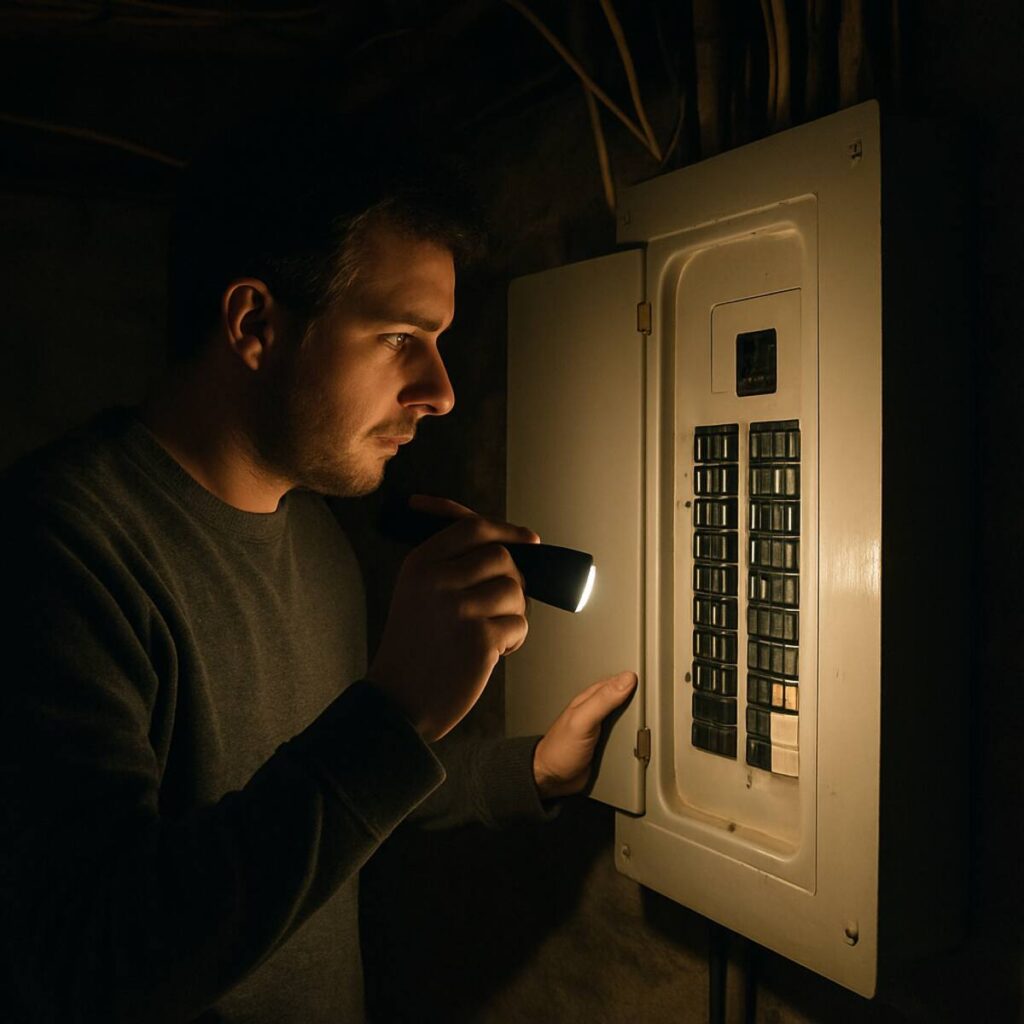
- Examine the Breaker Panel: Locate your main electrical panel. When checking for tripped breakers safely, always use a flashlight and ensure your hands are completely dry. Stand to the side of the panel rather than directly in front of it (a safety protocol to protect against arc flashes) and look for any breaker switches that have moved from the “ON” position to the middle, neutral position. To reset a tripped breaker, you must push it entirely to the “OFF” position until you feel a click, and then firmly push it back to “ON.”
- Suspect a “Dropped Leg” of Power: Residential homes in North America are typically supplied with two “legs” of 120-volt power, totaling 240 volts. If one of these legs fails—either at the utility pole, the meter, or the main breaker—half of your house will lose power, and your 240-volt appliances will fail to operate. This is a complex issue that requires an experienced local electrician or a utility worker to diagnose.
Total Home Power Loss: Checking the Main Breaker
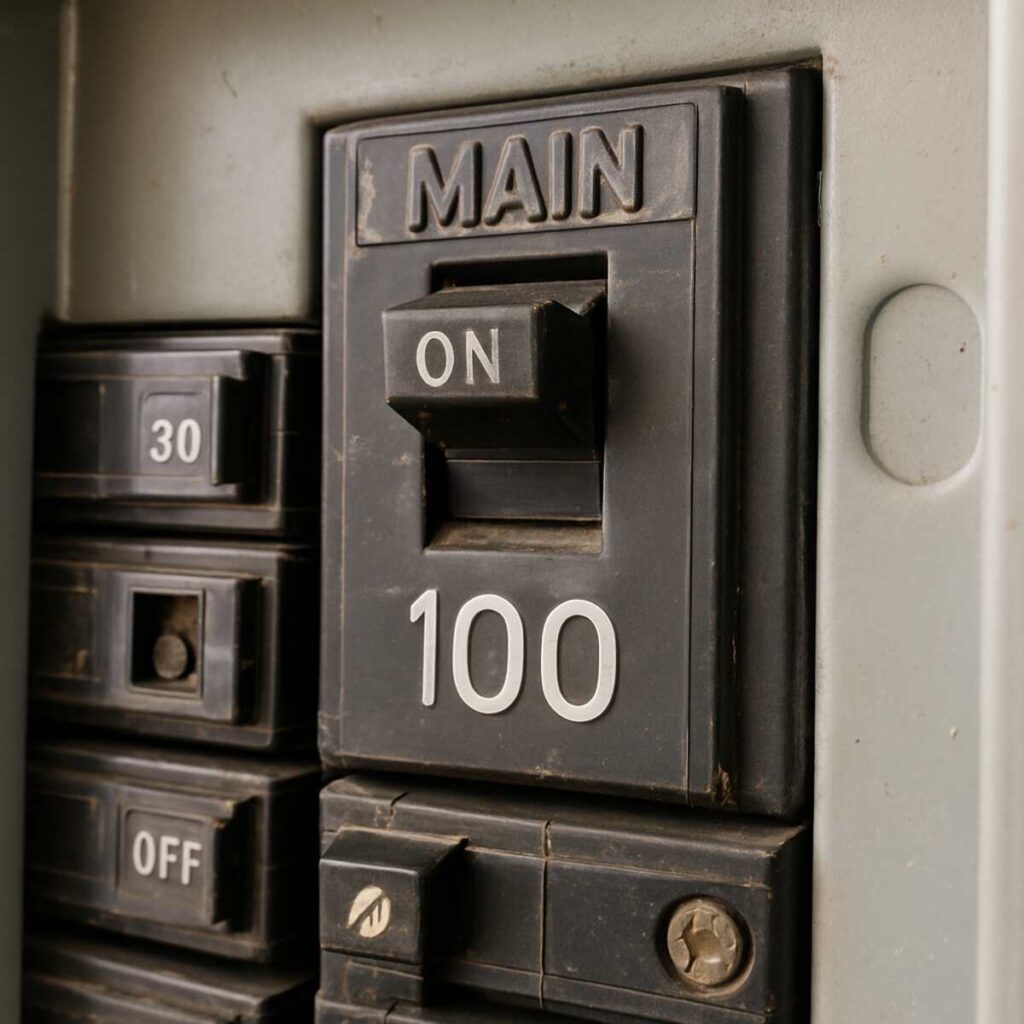
If your entire home is dark but the neighborhood is lit, the first place to look is your main circuit breaker. This is a large switch typically located at the very top or bottom of your electrical panel, usually labeled 100, 150, or 200 amps.
If the main breaker has tripped, follow the safe reset procedure mentioned above. However, if the main circuit breaker won’t stay reset and immediately trips again with a loud “pop” or sparks, stop immediately. This is a massive red flag indicating a severe dead short in your system, a failing panel, or a catastrophic overload. Forcing a main breaker to stay on against its safety mechanism can result in a devastating electrical fire. In this situation, you need to call an emergency electrician immediately.
Phase 3: The Blame Game – Utility vs. Homeowner
One of the most frequent points of confusion during a localized outage is determining who is responsible for the repairs. Many homeowners mistakenly believe that the utility company owns and maintains everything up to the electrical panel. This is incorrect.
Understanding utility company responsibility vs homeowner responsibility is vital for resolving your outage quickly and avoiding unnecessary dispatch fees from the wrong party.
The Demarcation Point
In the electrical industry, the line dividing utility equipment from homeowner equipment is known as the demarcation point. While slight variations exist depending on your municipality, the general rule of thumb is:
The Utility Company is Responsible for:
- The electrical grid (power plants, substations, high-voltage lines).
- The transformers on the utility poles.
- The “service drop” lines that travel from the utility pole through the air to your property.
- The actual electrical meter inside the meter box (the glass or digital mechanism that tracks your usage).
The Homeowner is Responsible for:
- The weatherhead (the hood at the top of the pipe where the overhead wires enter).
- The service mast (the metal pipe extending down the side of your house).
- The attachment hardware securing the mast to your home.
- The electrical meter box/base (the metal enclosure that houses the utility’s meter).
- The wires running from the meter box into your home.
- The main electrical panel and all internal wiring.
Repairing Storm Damage to Service Mast
This division of responsibility becomes painfully clear after severe weather. If a heavy tree branch falls and tears the power lines away from your house, the utility company will come out to reattach the lines. However, if the force of the falling branch bends your service mast, rips the weatherhead off, or damages the meter base, the utility company will refuse to reconnect your power until those components are repaired.
Repairing storm damage to service mast structures is strictly the homeowner’s responsibility and requires a licensed electrician. The electrician will need to rebuild the mast, secure the meter base, and pull proper permits. Once the repairs pass municipal inspection, the utility company is given the “green light” to return and re-energize the home.
Spotting Meter Base Issues
Sometimes, the issue isn’t as obvious as a fallen tree. The meter box attached to your siding is exposed to the elements 24/7. Over decades, water can intrude, causing the metal lugs inside to rust, loosen, and fail.
Be aware of faulty electrical meter box symptoms:
- Flickering or dimming lights throughout the entire home, especially when the wind blows.
- Half of the power in your home dropping out randomly.
- A visible gap between the meter box and your exterior siding.
- Rust creeping out from the bottom of the meter enclosure.
- A buzzing sound or burning plastic smell originating from the outdoor meter.
If you notice any of these signs, do not touch the meter box. It houses unfused, highly lethal voltage. Call a licensed local electrician immediately to assess the base.
Phase 4: Recognizing Signs of Internal Electrical Failure
If your exterior equipment is intact and the utility grid is fully functional, your power outage is caused by an internal failure. Electrical systems generally do not fail without warning, though those warnings are often subtle. Knowing the signs of internal electrical failure can help you catch a problem before it results in a total blackout or a fire.
1. Frequent Breaker Tripping
A circuit breaker is designed to trip when a circuit is overloaded, protecting the wires from overheating and melting. If a specific breaker trips once because you ran a space heater and a microwave simultaneously, it is likely just an overload. However, if a breaker trips repeatedly under normal loads, you either have a failing breaker, a loose wire, or an appliance that is short-circuiting.
2. Burning Odors and Discolored Outlets
Electricity should not have a smell. If you detect a lingering odor of fish, burning plastic, or ozone near an outlet, switch, or your electrical panel, it indicates that wiring is overheating and melting its protective insulation. Similarly, if you notice brown or black scorch marks around the slots of a wall outlet, the receptacle is failing and actively arcing.
3. Humming, Buzzing, and Sizzling Sounds
Your electrical panel and outlets should operate silently. A faint hum from a large transformer or a specialized dimmer switch can be normal, but loud buzzing or sizzling sounds from an outlet or the breaker box indicate arcing. Arcing occurs when electrical current jumps a gap between two loose connections, generating massive amounts of heat.
4. How to Tell if a Main Fuse is Blown
While modern homes use circuit breakers, many older or historic homes still rely on fuse boxes. If you lose power in a home with an older electrical system, you need to know how to tell if a main fuse is blown.
Unlike a breaker switch that clearly flips to the “OFF” position, a blown fuse requires visual inspection.
- Plug Fuses: For standard circuits, look through the glass window on the top of the fuse. If the metal filament inside is broken, or if the glass is smudged with black or brown discoloration, the fuse has blown and must be replaced with one of the exact same amperage.
- Cartridge Fuses: Main pull-out blocks usually contain cylindrical cartridge fuses. These do not have windows. To test them safely, an electrician will use a multimeter set to the continuity or resistance (Ohms) setting. If the multimeter beeps or shows zero resistance, the fuse is good. If it shows infinite resistance (OL), the fuse is blown. Warning: Never attempt to test or replace main cartridge fuses if you are not experienced, as the surrounding metal parts in a fuse block remain live and incredibly dangerous.
Phase 5: When to Call an Emergency Electrician
There is a distinct line between a minor electrical hiccup you can manage and a serious hazard requiring professional intervention. Knowing when to escalate the situation and hire an electrician for power outage resolution is critical.
The Role of the Emergency Electrician
An emergency electrician is a licensed professional who offers rapid response services, typically 24 hours a day, 7 days a week, including weekends and holidays. They are highly trained in diagnostics and carry a wide array of parts in their service vehicles to perform immediate repairs, making them your best resource when you are unexpectedly plunged into darkness.
You should immediately contact an emergency electrician if you experience any of the following:
- Water Infiltration in the Panel: If a pipe bursts or a roof leaks, sending water pouring down into your main breaker panel, do not touch it. The risk of electrocution is extreme. An expert must cut the power remotely or carefully disconnect the main before beginning emergency electrical panel repair.
- Post-Short Circuit Outages: If you plugged in an appliance, saw a bright blue flash, heard a pop, and lost power—and resetting the breaker does not restore it—the short circuit may have destroyed the breaker or melted the wiring inside the wall. Restoring power after a local short circuit safely requires testing the insulation resistance of the wires to ensure they are safe to re-energize.
- Melted or Burned Components: If you open your panel door and smell burning plastic, or see visibly melted wires or a scorched bus bar, do not attempt to reset any breakers. Close the door and call a professional.
- Medical Equipment Reliance: If someone in your household relies on electrically powered medical equipment (like an oxygen concentrator, CPAP machine, or dialysis equipment), a power outage instantly upgrades from an inconvenience to a life-threatening emergency. Rapid response is required.
What to Expect During the Service Call
When the expert arrives, they will initiate a process of residential electrical emergency troubleshooting. They will begin by communicating with you to understand exactly what happened leading up to the outage.
Next, they will use specialized tools, such as digital multimeters, thermal imaging cameras, and circuit tracers, to isolate the fault. If the issue is a dead short in a buried wire, they can locate it. If your electrical panel has suffered a catastrophic failure—such as a burned-out main bus bar due to a loose connection—they will provide options for an emergency electrical panel repair or a complete panel replacement.
Phase 6: Understanding the Costs
A common hesitation homeowners have when the lights go out is the fear of exorbitant repair bills. While emergency services command a premium due to the immediate, drop-everything nature of the dispatch, understanding emergency electrical service call rates can demystify the process and help you budget appropriately.
Breakdown of Emergency Rates
When you hire an electrician for power outage repairs outside of normal business hours, you are usually paying for a combination of the following:
- The Dispatch/Trip Charge: This is a flat fee charged simply to get the technician and their fully stocked vehicle to your doorstep. For emergency, after-hours, or holiday calls, this fee is typically higher than a standard Tuesday afternoon appointment.
- The Hourly Rate vs. Flat Rate: Some companies charge a premium hourly rate for emergency work, billing in 15- or 30-minute increments after the first hour. Other, more modern companies utilize “upfront, flat-rate pricing.” In this model, the electrician diagnoses the problem and presents you with a total, flat-rate cost to fix it before any work begins, regardless of how many hours it takes.
- Parts and Materials: Naturally, the cost of the replacement parts—whether it is a simple $20 circuit breaker, a $150 main breaker, or a completely new $2,000 electrical panel—will be factored into the final bill.
Is it Worth the Cost?
When debating whether to wait until Monday morning or pay an emergency rate on a Saturday night, consider the hidden costs of a prolonged outage.
- How much will it cost to replace an entire refrigerator and freezer full of spoiled groceries?
- If it is freezing outside, what is the cost of repairing burst water pipes if your heating system has no power?
- If it is sweltering, what is the cost of a hotel room for your family to sleep comfortably?
In many cases, paying the emergency dispatch fee is more economical than suffering the cascading consequences of a multi-day blackout.
Phase 7: Proactive Measures to Protect Your Home
The best time to deal with a power outage is before it ever happens. By taking proactive steps, you can shield your home’s electrical infrastructure from damage, reduce the likelihood of internal failures, and ensure that when the grid does go down, your life barely skips a beat.
Implementing Whole Home Surge Protection
One of the most dangerous moments of a power outage is actually the second the power comes back on. When utility companies restore grid power, it often surges back with massive spikes of voltage before stabilizing. These micro-surges can instantly fry the delicate microprocessors inside your smart TVs, refrigerators, HVAC systems, and computers.
While plug-in power strips offer a baseline level of defense, the whole home surge protection benefits are vastly superior. A licensed local electrician can install a whole-house surge protector directly into your main electrical panel. This device acts as a sentry; the moment it detects a massive voltage spike entering from the utility lines, it shunts the excess, destructive energy harmlessly into your home’s grounding system, protecting every single outlet and hardwired appliance in the house simultaneously.
Investing in a Backup Generator
If you live in an area prone to severe storms, rolling blackouts, or aging grid infrastructure, relying entirely on the utility company is a gamble. For total peace of mind, consider looking into a comprehensive backup generator installation guide.
There are two primary ways to approach backup power:
- Portable Generators with a Manual Transfer Switch: This is the budget-friendly approach. You purchase a gas- or dual-fuel portable generator and have an electrician install a manual transfer switch and an inlet box on the side of your house. During an outage, you wheel the generator outside, plug it into the house, fire it up, and manually flip the transfer switch. This safely powers critical circuits (like your fridge, well pump, and some lights) without “backfeeding” dangerous electricity onto the utility lines.
- Standby Whole-Home Generators: This is the ultimate luxury in outage protection. A standby generator is permanently installed outside your home, much like an air conditioning condenser, and is hooked directly into your natural gas or liquid propane supply. When an outage occurs, an Automatic Transfer Switch (ATS) detects the power loss, automatically turns on the generator, and seamlessly shifts your home’s power supply in a matter of seconds. You do not even have to get out of bed.
Scheduling Routine Electrical Inspections
Just as you take your car in for routine oil changes, your home’s electrical system requires preventative maintenance. Implementing an annual or bi-annual home electrical safety inspection checklist is an excellent way to catch deteriorating components before they leave you in the dark.
During a safety inspection, an electrician will:
- Ensure all smoke and carbon monoxide detectors are functioning and within their expiration dates.
- Test all GFCI and AFCI (Arc Fault Circuit Interrupter) outlets for proper operation.
- Inspect the electrical panel for signs of corrosion, loose connections, or improper wiring (like double-tapped breakers).
- Check the integrity of the grounding system and the outdoor meter base.
- Use thermal imaging to detect hot spots inside the breaker box that indicate loose, failing connections.
Phase 8: How to Choose the Right Electrician for Power Outages
When you are in the midst of an unexpected blackout, panic can lead to hasty decisions. Doing a quick web search and calling the first number that pops up can result in hiring an underqualified handyperson or an overpriced, subpar contractor.
Finding the right electrician for power outage repairs requires a brief but critical vetting process. Here is how to ensure you are hiring a competent professional:
1. Verify Licensing and Insurance
Never hire anyone to perform electrical work on your home who is not a fully licensed electrician. Electrical work is highly regulated for a reason—mistakes are lethal and can burn your house down. Ask for their license number and verify that they carry adequate liability insurance and worker’s compensation. If an uninsured handyperson gets electrocuted on your property, you could be held liable.
2. Look for 24/7 Availability
Not all electrical contractors offer emergency services. Many excellent commercial electricians strictly work Monday through Friday from 8 AM to 4 PM. When researching a local electrician, specifically look for those advertising 24/7 rapid response or emergency dispatch. Keep their number saved in your phone before an outage happens.
3. Read Reviews and Check Reputations
In today’s digital age, a company’s reputation is easily verifiable. Look at Google, Yelp, and Better Business Bureau reviews. Pay close attention to reviews that mention emergency calls. Did the electrician arrive on time? Were they transparent about their pricing? Did they clean up after the job was done? A pattern of positive reviews regarding after-hours repairs is a strong indicator of reliability.
4. Demand Upfront Pricing
As mentioned earlier, the anxiety of an emergency repair is compounded by the fear of an unknown bill. The best electrical contractors will assess your partial or total home power loss, diagnose the root cause, and present you with a clear, written, upfront quote before they ever pick up a tool. This eliminates surprise fees and allows you to make an informed financial decision.
5. Ask About Warranties and Guarantees
A reputable emergency electrician stands behind their work. Ask if they provide a warranty on the parts they install and the labor they provide. If they perform an emergency electrical panel repair and a breaker fails a week later, you need to know they will return to rectify the situation at no additional cost to you.
Conclusion
A power outage is an incredibly stressful event that disrupts your routine, threatens the safety of your home, and tests your patience. However, armed with the right knowledge, you can navigate these dark moments with confidence.
By understanding the difference between utility company and homeowner responsibilities, learning how to safely check for tripped breakers, and recognizing the early warning signs of internal electrical failure, you can prevent minor issues from turning into major catastrophes. Furthermore, by proactively investing in whole-home surge protection, routine safety inspections, and backup generator systems, you can fortify your home against the unpredictable nature of the grid.
Most importantly, you now know exactly what it takes to find a qualified, reliable emergency electrician. Do not wait for the lights to go out to start your search. Research and select a trusted local electrician today, save their contact information, and rest easy knowing that if you are ever left in the dark, professional help is just a phone call away. Ensure your family’s safety and comfort by treating your home’s electrical system with the respect and professional care it requires.