



Tired of complex board games with hour-long setups? Meet Trash (sometimes called Garbage), the card game you can learn in five minutes and play for hours. It’s the perfect answer when you need a simple, engaging activity that everyone from young kids to grandparents can enjoy together. All you need is a standard deck of cards and at least one other person to get started. To find more, check on cadetv.com
The goal of Trash is wonderfully simple: be the first player to arrange your cards in numerical order from 1 to 10. You’ll use Aces as your number 1s, 2s as your 2s, and so on, creating a neat line of cards that signals you’ve won the round. This straightforward objective is what makes the game so quick and satisfying.
Unlike games that require special score pads or unique components, Trash keeps it minimal. A single 52-card deck provides all the action, making it an ideal choice for travel, family nights, or a spontaneous moment of fun. The simple rules put everyone on an even playing field, where a bit of luck is all it takes to win. This guide walks through the setup and rules so you can get right to playing.
How to Set Up the Game: Your 3-Step Dealing Guide
Getting the game set up is quick and easy. Before you can start playing, each person needs to create their own personal layout of cards. This is your game board for the round, representing the numbered slots you’re trying to fill.
Here’s the official setup for the game, step-by-step:
- Shuffle one standard 52-card deck thoroughly. If you have 5 or more players, shuffle two decks together.
- Deal 10 cards face-down to each player. Don’t look at them!
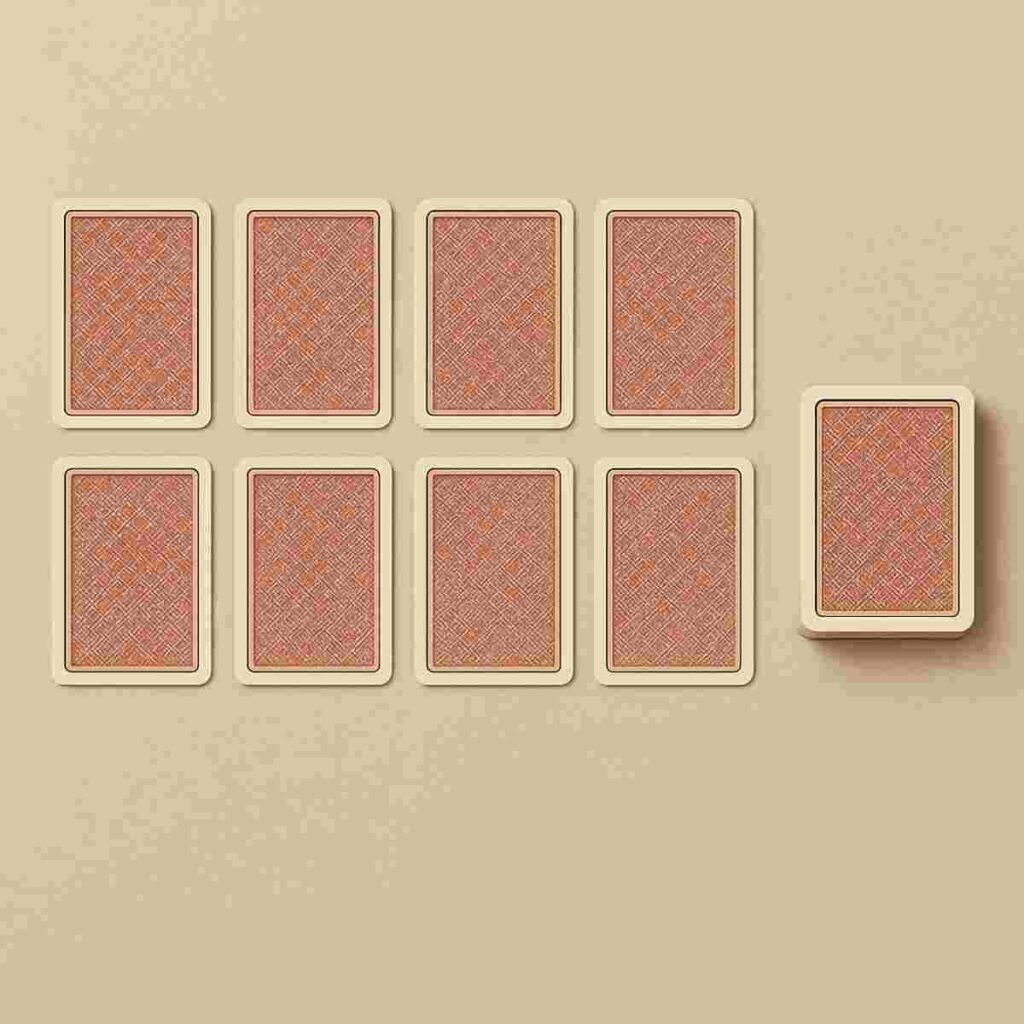
- Arrange your cards in front of you in two neat rows of five. This 10-card grid is where all the action happens. Think of the top-left card as your “1” spot and the bottom-right as your “10” spot.
After everyone has their layout, place the rest of the deck face-down in the middle of the table. This stack is your draw pile. Leave a space right next to it—that’s where the discard pile will form as soon as someone discards their first card.
Playing a Basic Turn: A Step-by-Step Walkthrough
Your turn begins with a simple choice: you must draw one card. You can either take the top card from the face-down draw pile or grab the top card from the discard pile if you think it can help you. Playing Trash is all about knowing what to do with the card you’ve just drawn.
Next, you need to see if the card is useful. A card’s number value corresponds to a position in your layout. The spots are numbered 1 through 10, starting with the top-left card as spot #1 and ending with the bottom-right card as spot #10. Aces are always used as 1s, 2s are 2s, and so on, up to the 10s. A card is only useful if its matching spot in your layout is still face-down.
For example, let’s say you draw a 6. You would look at the sixth spot in your layout (the first card in your bottom row). If that spot still has a face-down card, you can place your 6 face-up on top of it. If you already have a 6 turned face-up, then the new 6 you just drew is no use to you, and you must discard it, ending your turn.
When you successfully place a card like that 6, you must pick up the face-down card that was in its spot. This new card in your hand might also be playable, setting off an exciting chain reaction.
The Chain Reaction: What to Do with the Card You Picked Up
That new card you just picked up from your layout is your key to continuing your turn. Think of it as a free play. Let’s say you placed that 6, and the face-down card you picked up was a 2. You immediately look at your second spot. If it’s still face-down, you can place that 2 right there and then pick up the card that was underneath it.
This process can create an exciting chain reaction that is the heart of the game. If the card you picked up from the ‘2’ spot is a 9, you can then play it in your ‘9’ spot, and so on. Your turn continues as long as you keep revealing cards from your layout that you can legally place. On a lucky turn, you might flip over several cards at once.
Eventually, your streak will come to an end. Your turn stops the moment you pick up a card—either from your layout or the draw pile—that you cannot use. This usually happens when you reveal a number card for a spot that already has a face-up card. For example, if you pick up another 6 from your layout after you’ve already placed one, you have nowhere to put it.
To officially end your turn, you must discard the unplayable card you are holding. Simply place it face-up on top of the discard pile for the next player to see. This single action passes the turn.
The “Wild” Card: How to Use a Jack to Your Advantage
While some face cards can stop your turn cold, the Jack is your best friend. A Jack is a “wild card,” meaning it can transform into any number card you need, from Ace (1) to 10. For example, if you draw a Jack from the pile and the only spot you have left to fill is your ‘7’ spot, you can place the Jack there. For the rest of the round, that Jack now acts as your 7.
Using a Jack is one of the fastest ways to get ahead. It lets you fill a stubborn empty spot and, more importantly, continue your turn by picking up the face-down card underneath it. The real magic happens when you draw the number card you actually need. According to the official game rules, you can swap them. If you later draw an 8 and you have a Jack sitting in your ‘8’ spot, you can make the trade.
This swap is a powerful move. You place the real 8 in its correct spot and then pick the Jack back up to continue your turn. Now you’re holding a wild card again that you can use on any other open spot! Using the Jack swap effectively is a huge part of winning. While Jacks are always helpful, the other face cards—Kings and Queens—are simply roadblocks.
The “Problem” Cards: How Kings and Queens Work
Unlike the helpful Jack, Kings and Queens are roadblocks. You can never place them in your layout of 1 through 10. Instead, they trigger special actions that can either help you slightly or end your turn on the spot.
Drawing a Queen is the real “trash” moment in the game. If you pick up a Queen from either the draw pile or the discard pile, your turn is immediately over. You have no other choice but to place it face-up on the discard pile, and then play passes to the next person. It’s a complete stop sign.
Kings, on the other hand, offer a small bit of luck. If you draw a King, you also can’t play it, but it doesn’t end your turn. You place the King on the discard pile and then get a “do-over” by drawing another card. So, while you can’t use a King in your layout, it gives you a free second chance to find a card you need.
Both Kings and Queens must be discarded right away. A Queen ends your turn, while a King lets you try again. They are just temporary hurdles in your quest to fill your layout.
How to Win a Round (And What to Shout When You Do!)
The moment of victory arrives when you successfully place the final card needed to complete your layout. This means every spot, from 1 through 10, is filled with either the correct number card (Ace for 1, 2 for 2, etc.) or a wild Jack.
As you place that final winning card, you must announce your victory! The traditional way to do this is by shouting “Trash!” or “Garbage!” loud and clear. If you forget to say it, the round isn’t officially over, so don’t be shy about celebrating.
The second you make that announcement, the round comes to an immediate halt. It doesn’t matter if another player was one card away from finishing—your win stops all action. The objective of Trash is to be the first person to complete your layout and declare it. There’s no complex scoring; you either win the round or you don’t.
Playing Subsequent Rounds to Win the Whole Game
Winning a round is exciting, but the game is just getting started. As a reward for winning the 10-card round, that player gets a big advantage: in the next round, they only have to deal themselves nine cards. Everyone else still has to get a full ten cards.
This pattern continues round after round. If you win the nine-card round, you’ll play the next one with eight cards, then seven, and so on. It’s a race to zero! If a different player wins a round, they get to “level up” too. For example, if a player with ten cards wins, they’ll play the next round with nine, joining anyone else who has already reached that stage.
The ultimate goal is to be the first person to work your way down to a one-card round. Winning this final, lightning-fast round is how you win the entire game. Since your layout only has one spot, you just need to draw an Ace (the “1” card) or a wild Jack to instantly win and be crowned the champion. There is no complex scoring; you simply track who is on what card level from one round to the next.
Trash Rules FAQ: 2 Players, Multiple Decks, and Common Variations
Once you’ve played a few rounds, you’ll see how flexible the game can be. A few questions tend to pop up, especially when you change your group size or want to add a twist.
The trash card game with 2 players is one of the most popular ways to play, and a single 52-card deck is all you need. For larger groups of four or more players, it’s a good idea to shuffle two full decks of cards together. Doing this ensures there are enough number cards and Jacks to go around.
Many families and groups add their own “house rules,” which is a big part of the fun with trash card game variations. The most popular one is to make Kings wild, just like Jacks. This adds more excitement and speeds up the rounds. Just make sure everyone agrees on any house rules before you start dealing.
Here are quick answers to the most frequently asked questions:
- Q: What if the draw pile runs out?
- A: Leave the top card of the discard pile where it is, then scoop up the rest, shuffle them thoroughly, and place them face-down to create a new draw pile.
- Q: How many decks do I need for a big group?
- A: For four or more players, shuffle two decks together.
- Q: Are Kings wild?
- A: Not officially, but it’s a very common and fun house rule to add.
You’re Ready to Play: A 3-Minute Recap of the Rules
To help during your first few hands, here is a quick-glance summary of the rules:
- Setup: Each player gets 10 face-down cards in a 2×5 grid.
- Goal: Be the first to flip over all your cards by filling spots 1 (Ace) through 10.
- Your Turn: Draw a card. If you can use it, place it and play the card you picked up. Your turn ends when you discard a card you can’t use.
- Special Cards: Jacks are wild and can fill any spot. Queens are duds and end your turn immediately. Kings are freebies that let you discard them and draw again.
- Winning: Win a round and play with one less card next time. The first to win the one-card round is the champion!
A simple deck of cards can instantly transform a quiet evening into a fun, fast-paced race to one. Grab a deck, a friend or two, and play your first round. It’s time to turn some cards into treasure.
